

A car breaks down, a tow truck arrives within the hour, and everything feels like it is back under control. Then, a few days later, the car starts slipping between gears. There is a strange noise when accelerating. Something is clearly wrong, and it has nothing to do with the original breakdown.
This scenario happens more often than most drivers realize, and the cause is not always obvious: the transmission was damaged during the tow itself. Understanding how towing can affect your transmission is not just useful knowledge for mechanics. It is something every driver should know before they ever need to make that call.
This article covers how your transmission works, what actually happens when a vehicle is towed incorrectly, which vehicles carry the most risk, and how to protect yourself the next time you find yourself on the side of the road. If you are in Orlando and need a tow you can count on, Nimble Towing Service is available at (407) 357-0777 any time you need us.
The transmission is the system that transfers power from the engine to the wheels. It controls gear changes and keeps your engine running at the right speed for your road speed. Inside an automatic transmission, a pump driven by the engine circulates fluid that lubricates and cools the internal components. That pump only runs when the engine is on.
This detail matters a lot when it comes to towing. If the driven wheels are rolling while the engine is off, those internal components are still moving. Without the pump running, there is no fluid circulating to lubricate them. That is where the damage begins.
Not all tow trucks operate the same way, and the difference has a direct impact on your vehicle’s safety during transport.
Wheel lift towing uses a metal yoke to raise either the front or rear wheels off the ground. The remaining two wheels stay in contact with the road and roll along as the truck moves. This method is common and works well for certain vehicles in the right conditions.
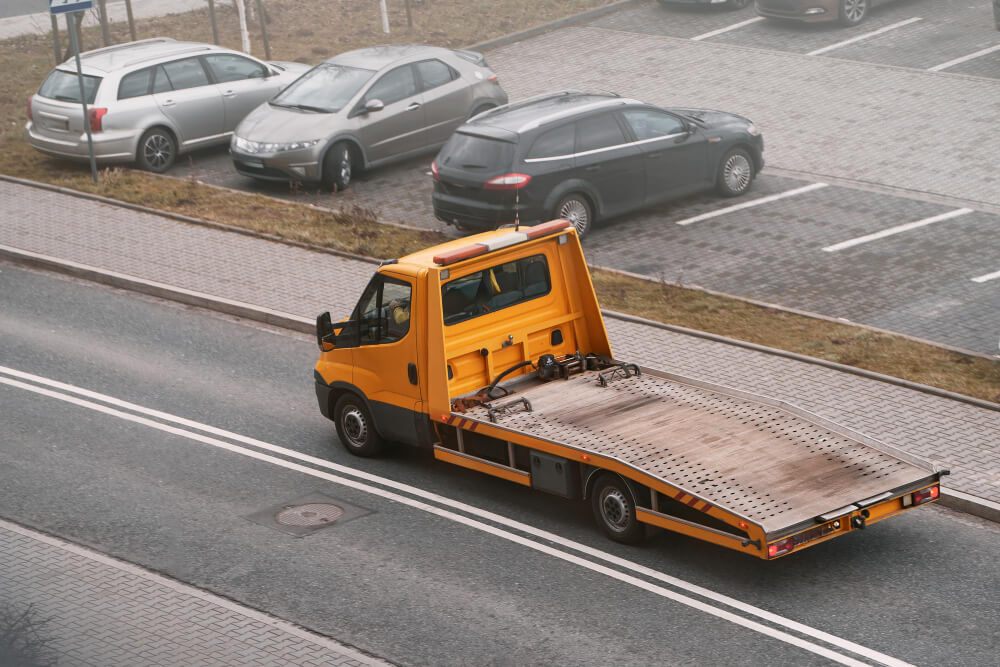
Flatbed towing uses a flat platform that tilts to load the vehicle fully. All four wheels leave the ground, and the entire vehicle rides on the bed without any rolling contact. This is generally considered the safest method for most modern vehicles.
The method used, and specifically which end of the car gets lifted, can determine whether a tow causes transmission damage. That is not a minor detail. It is one of the most important factors in the entire process.
Yes, towing can damage your transmission, and it comes down to one core problem: lubrication.
When a vehicle with an automatic transmission is wheel lift towed with the driven wheels on the ground, those wheels spin the driveshaft and the transmission components connected to it. Because the engine is off, the transmission pump is not running. The internal parts that depend on fluid are rotating without proper lubrication, which causes friction and heat to build up in components that were not designed to handle it under those conditions.
For many vehicles, even a relatively short tow with the wrong wheels rolling can generate enough heat and wear to cause real transmission damage. In some cases, the damage is immediate. In others, it develops gradually and shows up days or weeks later, which is why many drivers never connect the problem back to the tow.
Manual transmissions carry a lower risk, but they are not immune. Depending on the drivetrain configuration, some manual vehicles can also sustain damage if towed incorrectly.
A front-wheel drive vehicle towed from the rear with the front wheels rolling is in a vulnerable position. The front wheels are the driven wheels, meaning they are connected to the transmission. Rolling them without the engine running is exactly the situation that causes fluid starvation inside the transmission.
These carry the highest risk of all. In an AWD or 4WD vehicle, all four wheels are connected through the drivetrain. That means there is no safe end to lift with a wheel lift tow. If any wheels are left on the ground and rolling, drivetrain components are turning without lubrication. For these vehicles, a flatbed tow is not just the better option. It is the only safe one.
EVs present a different but equally serious concern. Many electric vehicles use regenerative braking, which means the wheels turning actually feeds energy back through the motor. Rolling the wheels during a tow can cause the motor to generate electricity when it is not designed to operate that way, which can create issues with the electrical system and onboard components. Most EV manufacturers explicitly state in their owner’s manuals that their vehicles must be transported on a flatbed.
A rear-wheel drive vehicle towed from the front is generally in a safer position, since the non-driven wheels are rolling. However, some configurations still involve driveshaft rotation, so it is worth checking the manufacturer’s towing guidelines even for these vehicles.
Transmission damage from an improper tow does not always announce itself right away. These are the warning signs worth watching for in the days following a tow:
If any of these symptoms appear after your vehicle has been towed, have a mechanic inspect the transmission before dismissing it as a coincidence.
Here is something most drivers do not think about until it is too late: when you call for a tow, you often have no control over what type of truck shows up unless you specifically ask.
Not every towing company dispatches the right equipment for every vehicle. A driver with an AWD crossover or a front-wheel drive sedan asking for “just a tow” might get a wheel lift truck by default, especially if the dispatcher does not ask about the vehicle type or the driver does not know to volunteer that information.
The simple fix is to ask before the truck is dispatched. When you call, mention your vehicle’s drivetrain type and ask whether a flatbed will be sent. That one question can prevent a repair bill that costs several times more than the tow itself.
In Orlando, Nimble Towing Service dispatches flatbed tow trucks for vehicles that need them. When you call us at (407) 357-0777, our team asks the right questions upfront so the right equipment shows up the first time.
Towing does not have to damage your transmission. But towing without the right method for your specific vehicle is where costly and preventable damage happens, often without the driver ever realizing the tow was the cause.
The key takeaways are straightforward: know your vehicle’s drivetrain type, understand that AWD and FWD vehicles are the most vulnerable to transmission damage from wheel lift towing, watch for warning signs in the days after a tow, and always ask what type of truck is being sent before it arrives.
Saving a reliable towing number before you ever need it is one of the simplest ways to protect your vehicle. Nimble Towing Service is available in Orlando at (407) 357-0777. When you call us, you can count on getting the right equipment for your vehicle and a team that takes the details seriously.